
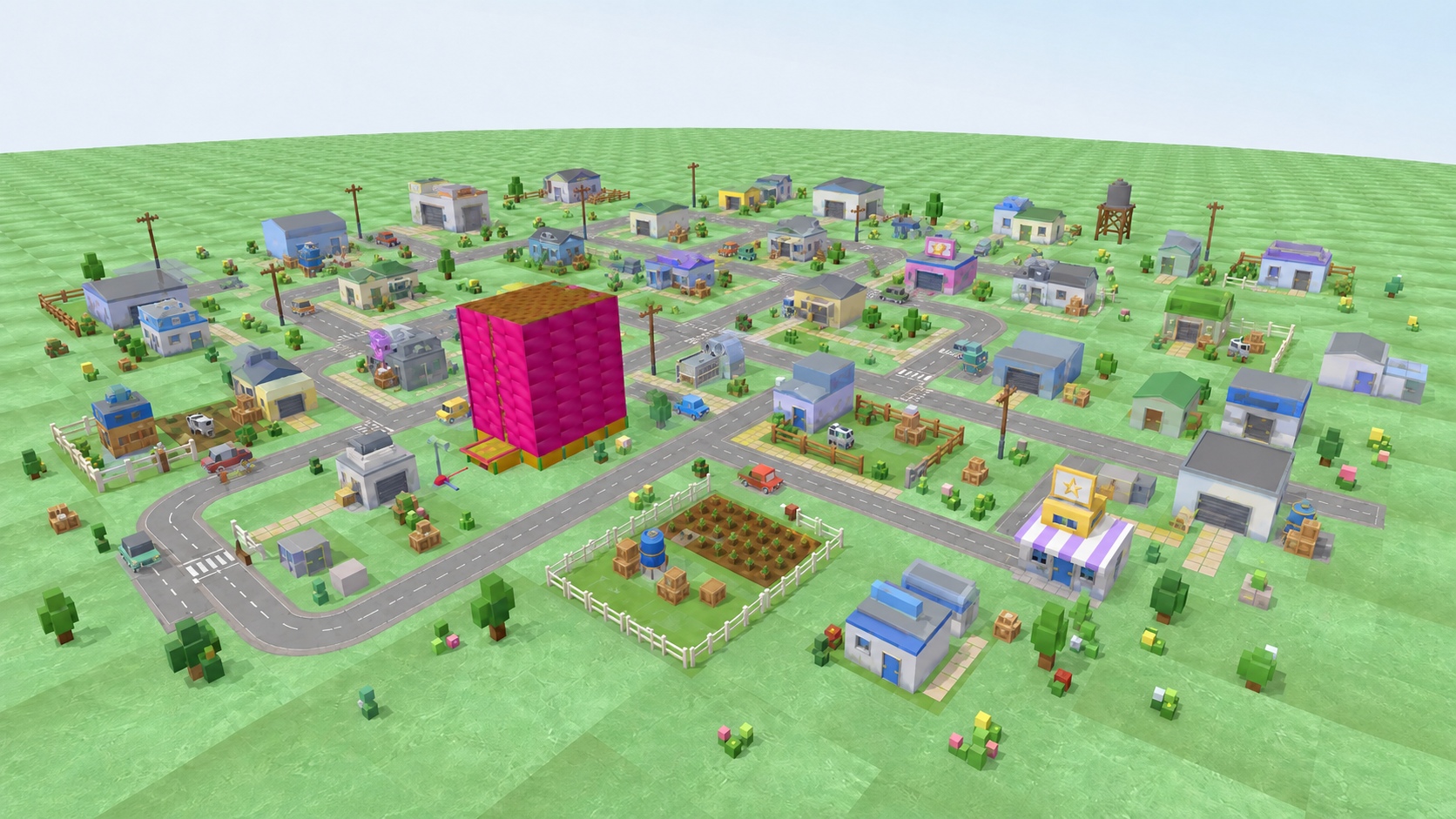
Open World Zone as a 3D Knowledge Habitat
By Open World Zone
I wrote this as a relaxed product note while building Open World Zone.
My first principle is: "write words on the wall, put photos on the wall".
I am building it as a personal long-term knowledge habitat + a lightweight open world engine.
I want to solve the note black hole. Things I save somewhere, if I do not actively search for them, and searching means I must first remember the keywords, may never see daylight again.
I do not want to make an independent 3D note app. I want to use 3D to wrap 2D notes, as a bridge between the 2D internet and a more spatial way of using information.
One thing that often makes me stuck is this: some people think this is my main note system. But in my mind it is auxiliary, it is for walking around and reviewing, and it has a matching flat management system. I do not want to force every habit into 3D.
People are willing to spend a long time in a space that belongs to themselves.
It does not solve efficiency. It solves "why people still want to open it".
I want to leave my own trace in the wide internet world.
A permanent kind of entity world.
Habitat
3D space is suitable to be a habitat for long-term structured knowledge, not the only entrance for every small fragment note.
I need to keep two channels: "2D index + 3D space". I should not force all information to be visited through 3D.
I already understand this point:
The "bookshelf" in the 3D world can have a matching flat web page. The flat web page is responsible for SEO and search. The 3D part is responsible for immersion and daily walking around.
This is the direction I want to keep.
Use the strong natural spatial memory ability of human beings, and bind abstract information to concrete places.
And it must be programmable.
Details
-
Using space to manage knowledge has stable user need. But most products stay at "2.5D canvas / 3D graph". They did not really become that kind of first-person walking world.
-
More importantly, 3D space is more interesting than 2D. People like to walk around in 3D space more. So they review things in this way.
-
Human beings have very strong natural spatial memory ability. They bind abstract information to concrete places. Sense of space is one of the things the brain is best at. When I put information into space, the brain more easily remembers where it is.
-
It is similar to Microsoft's "The Task Gallery: A 3D Window Manager" around year 2000.
-
I can ask someone: "Where was the cardboard box with old toys in your childhood home?" He can often tell me at once: "Turn left at the second floor stair mouth, the bottom layer of the second cabinet."
-
Tools such as Obsidian and Notion use tags and bidirectional links to build knowledge graphs. This is perfect in logic, but against intuition in body feeling. Human beings are better at this: "I put the note about 3D rendering on the blackboard on the right side of the second floor balcony in my virtual villa."
-
Only 40kb rendering engine + physics engine. This size is smaller than a normal JPG picture. Minecraft's voxel grid is good, but it is hard to show the beauty of modern buildings, and the memory use of making a web version is very large.
-
For note users, the most frightening thing is platform shutdown, like many recent cloud note problems. My product supports both online use and complete local storage, so it greatly lowers the user's trust threshold.
Audience
My current rough audience guess:
- ADHD groups or visual thinkers: This group has a very high share in Europe and America, and has strong buying power. They have difficulty using traditional linear notes, but are very sensitive to space, color, and geographic position.
- Novel writers and worldbuilders: Writers of fantasy and science fiction need to remember dozens of characters and hundreds of place names. If each room in a 3D castle can hold one family's files, this is surely a strong need and pain point.
- Postgraduate exam people / lawyers / medical students, which means people who need strong memory methods: I may present it as real virtual memory palace software for overseas users.
A Later Sorting Helper
- Later sorting assistant: I want to let people throw in hundreds of web page bookmarks, then let the product build new rooms according to meaning and put them into rough categories. For example, on the second floor it may open a new room for machine learning notes, and the walls are full of related papers and models. The point is simple: let objects return to their proper place.
Social Attribute
I want users to generate a special URL. This is very important. Like Animal Crossing, they can invite friends to walk around in their own "knowledge villa". I like that feeling: someone builds in the west of the city, and I build in the north of the town.
Why Blank?
The internet of the past 20 years was an era kidnapped by efficiency metrics, KPI, click rate, and ad conversion rate. Capital asked people to put as much information and ads as possible into one flat plane. The character of 3D space, walking slowly and slow life, looked out of place in the fast food era.
But today, the situation has changed. The sea of information is already flooding. Tools can create huge useless data every day. People no longer lack information.
Also, many earlier products tried and failed many times. They found that 3D space management of information can easily have more form than content, and it may greatly increase the friction of getting information.
A personal knowledge base is used to produce and retrieve. I cannot expect a person who is hurrying to write a paper to search for materials every day in his "virtual museum" for a long time.
So 3D is not used to "take notes". It is used to make macro visualization of knowledge. It can only reduce pain.
It is not the fastest way to type or search, so I should admit that honestly. I would rather present it as a slow, personal knowledge space, not compete directly with pure efficiency tools.
Weak Points
Spatial memory is god-level when handling 50 to 200 objects, for example I clearly know what is inside every drawer in my living room, bedroom, and kitchen. But when I face "book spines of 300,000 books", spatial memory will collapse at once.
Even if every floor of one building has very clear categories, when my note number passes 1000, "the third shelf in the 14th room on the left side of the corridor" is no different from "a string of messy code" for the brain.
In a 3D world, words pasted on the wall often have perspective skew, are affected by light and shadow, and WebGL text rendering, whether using Canvas texture or SDF, is hard to reach DOM-level native text subpixel anti-aliasing effect.
After looking for a long time, the eyes will be very tired. This is why in The Elder Scrolls or GTA, although there are books to read, once I click one, the game must flatten this page of paper in the center of the screen and turn it into 2D for reading. So this method must be learned.
Is It a Game or a Tool?
I still think it should be a productivity tool...
3D space has very limited help for note functions. The worry is obvious: will this project always feel more like a game than a tool?
I used to think only something that lets people type and search at the fastest speed can be called a tool. Something immersive and letting people walk everywhere is easily called a game.
Typing an outline on a computer is fast. But why do many top startup teams and researchers still put sticky notes on a huge physical whiteboard, and even pull lines between them? Because spatial arrangement itself is a thinking process. My 3D library is, in essence, an infinite and architectural super 3D whiteboard. This is why I still see it as a productivity tool.
Current note software, such as Notion and Evernote, is like a black hole. Things I save inside, unless I actively search them, and that means I first remember the keywords, may never see daylight again.
Also, it can create accidental meetings. When I walk to the second floor to find note A, the corner of my eye sees note B hanging on the corridor wall, maybe something I saved one year ago.
Although "3D is only used as display", display itself is a very huge business need.
Examples
A scholar who studies Hong Lou Meng no longer gives others a cold personal website link. He gives out a 50kb link generated by openworld-js. After clicking it, it is an antique 3D Chinese courtyard, controlled by first person or gamepad. Each room displays his research results of different chapters and 2D detail entrances. This 3D space is the tool he uses to build professional authority.
If a history teacher makes World War II history into a 3D building, with floors divided by year, and lets students directly "walk around" on the web page, then for the education industry, this is a teaching courseware tool with a very strong lower-dimensional attack feeling.
Novelists build worldviews, directors draw storyboards, and designers find inspiration. They really need a 3D space to hang up hundreds of pictures and setting collections and look around.
Ah... I do not know whether it will happen. Are people tired of Notion's table interface full of work pressure? Do people want a small cabin in the digital world where they can breathe?
After work, I hold a cup of coffee, pick up a gamepad, and walk in the "knowledge villa" accumulated by myself in the past year. I look at the full walls of 2D note cards, video picture frames, and 3D model ornaments... What a beautiful thing. The data size is very small, and it can be saved and kept for a long time.
Other
The library I released in October 2025 last year was only an extreme test. Do not take it too seriously.